
Every single year on the tea foraging and sourcing missions I go on, there is a tea that – for any number of reasons – I miss out on acquiring. Here, I’m speaking about good teas that ‘hit’ me. The qi is there, the liquor carries some bite, and the mineral depth of the flavours over infusions seems to evolve. These teas more often than not, come into my sphere (and onto my palate) by simply being in the tea zones – a bit of good grace by being able to immerse myself in source regions.
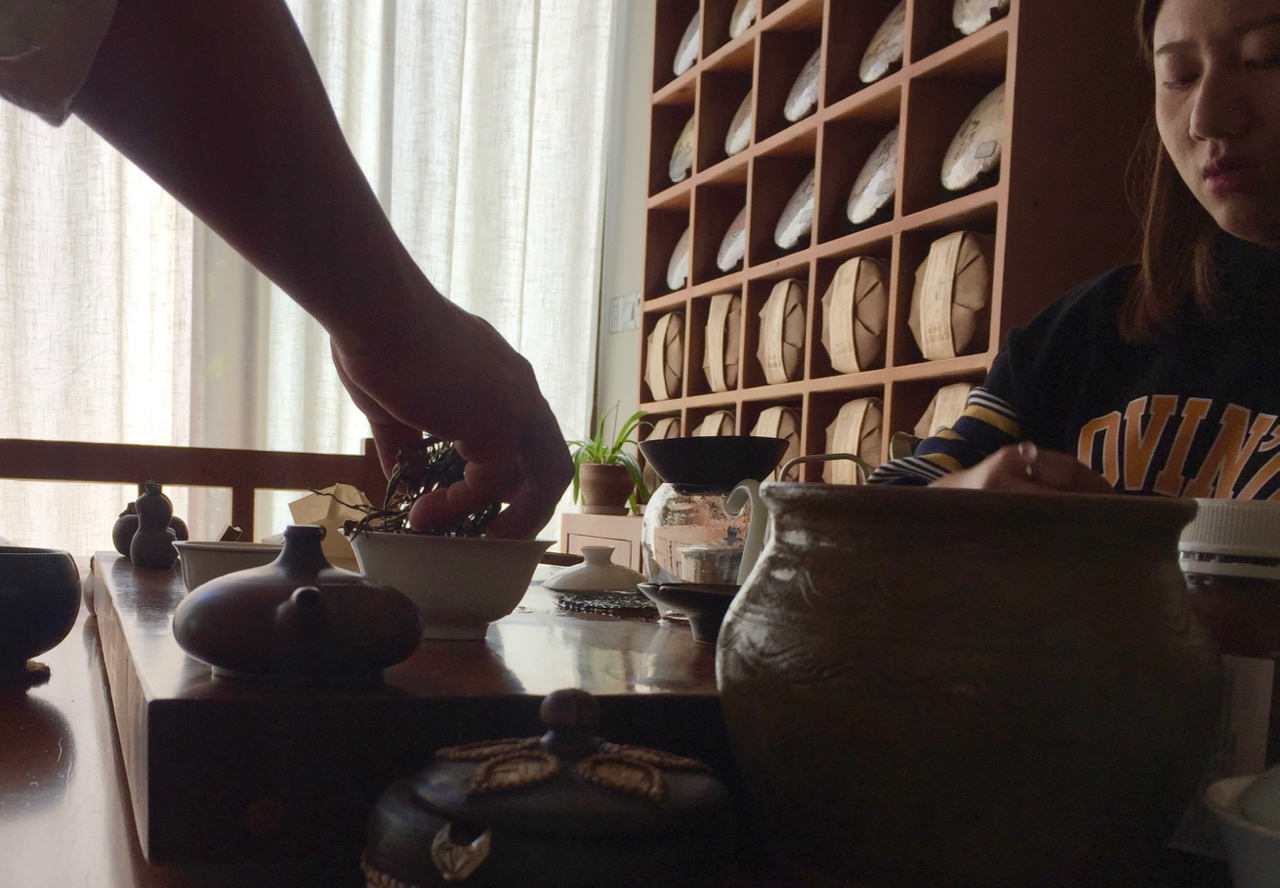
That sanctuary of the dried leaf: The Tea House
This particular cake (of which there were two) was what I’ve subsequently come to refer to as ‘2018’s tea that didn’t quite make it into my collection. A ten-year-old Sheng (10 is plenty old enough in my palate pleasure box) Lao Banzhang that was a deep, luscious, tang-filled wonder. Despite an afternoon of shooting multiple offerings, the qi in this cake was cracking, even after all of the quality on offer earlier in the day. It did what I believe (and have been taught to expect) good Puerhs should: be clean with some bite, hit with a nice secondary mineral-waft in the back of the mouth, and finish soft. And then there was the qi dimension. It didn’t simply come and go. It came, and came again…and then returned with every successive infusion. It was that thrilling heat-seeking clarity that comes when a tea has been through minimal manipulation by us humans – just enough to usher the leaves (good leaves from good soil) on their way to a desiccated state, and a cup.
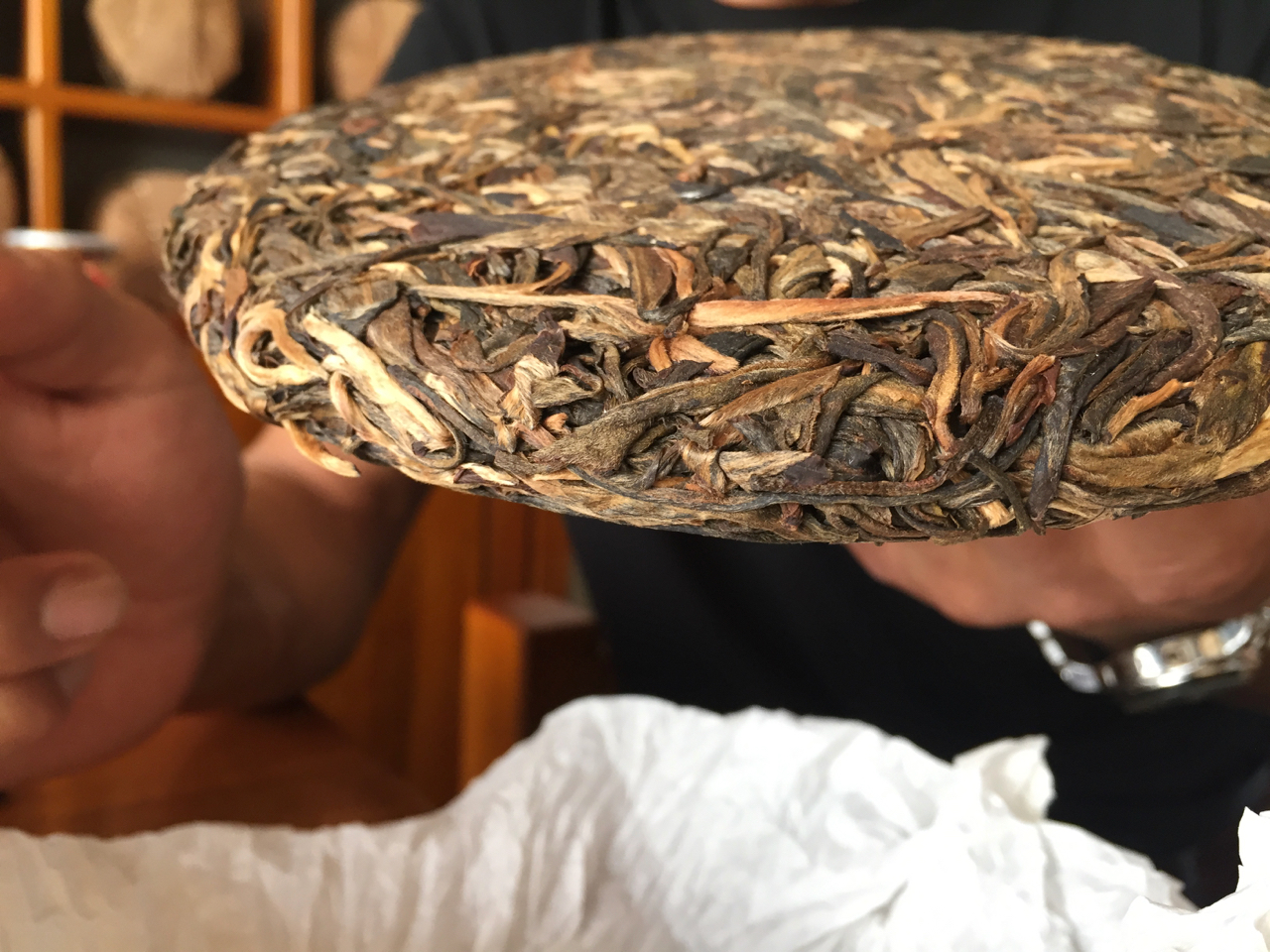
The cake that got away…and melted the blood.
The gentleman who brought the tea in knew it was something special. He was a buyer/seller from near Hangzhou, and had purchased the leaves and pressed the cake himself years ago, and kept the cakes in a strict dry-storage environment and emphasized one of the great underrated aspects of stored or ‘aged’ Puerhs: that “without knowing storage conditions, you do not know your tea”. And how often do we hear the ambiguous terms of “old”, “ancient”, “at least 30-years” in modern Puerh conversations? A little too often, I’d venture.
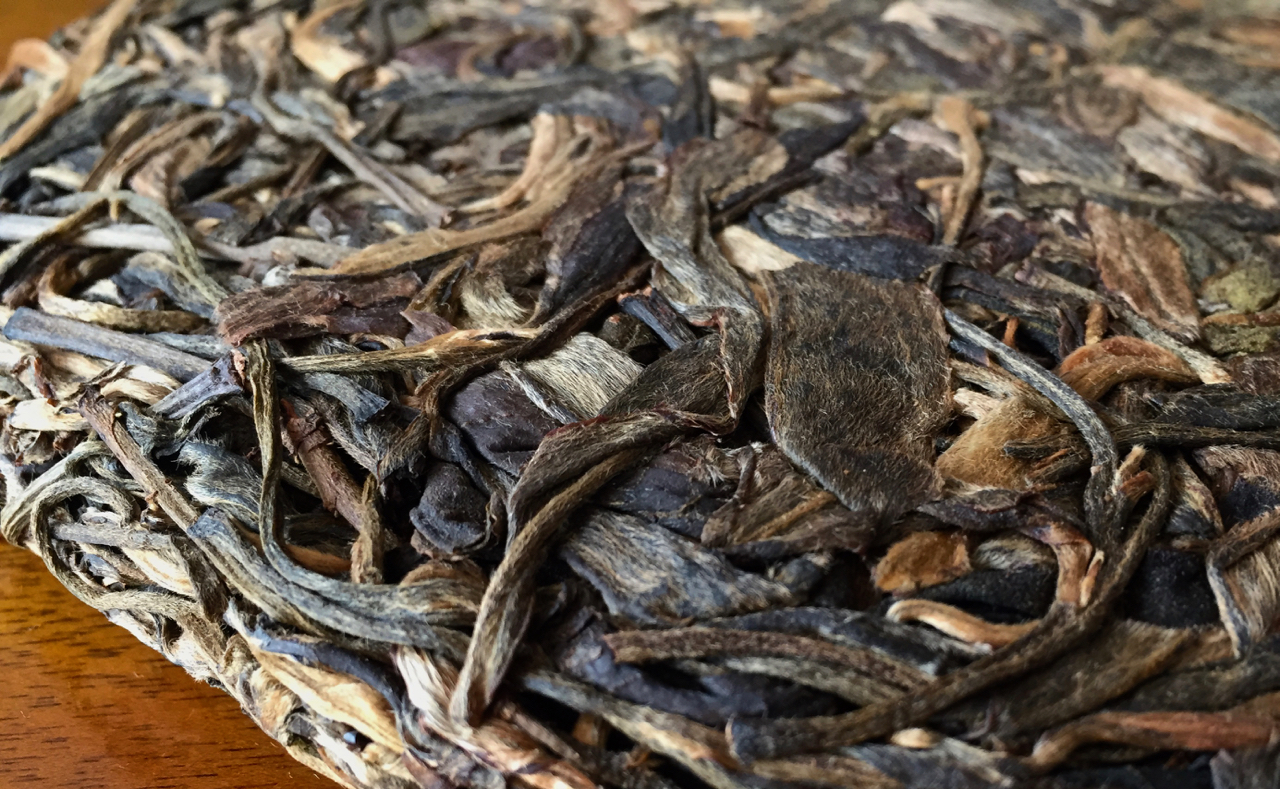
Some of the magic within. Loads of end buds with their ‘fuzz’, along with a nice smattering of fully mature leaves.
We sat in a friend’s tea shop in Menghai and he brought this stunner to simply share. My own offer to purchase the untouched remaining cake was an awkward moment that brought a smile. He could smell my fever, “But it isn’t for sale”, he said. This kind of wording often simply means, “It is for sale, but it will take some time to get to a number I like”. In the end, it simply wasn’t for sale. Not to me, nor to two other friends sitting with us. It was simply to share. It reminded me (painfully, as I still lust after it, every time I remember its golden buds) that the spirit of tea houses, was/is/should be, to share. The 2018 ‘tea that got away’ was one, that would only be shared.
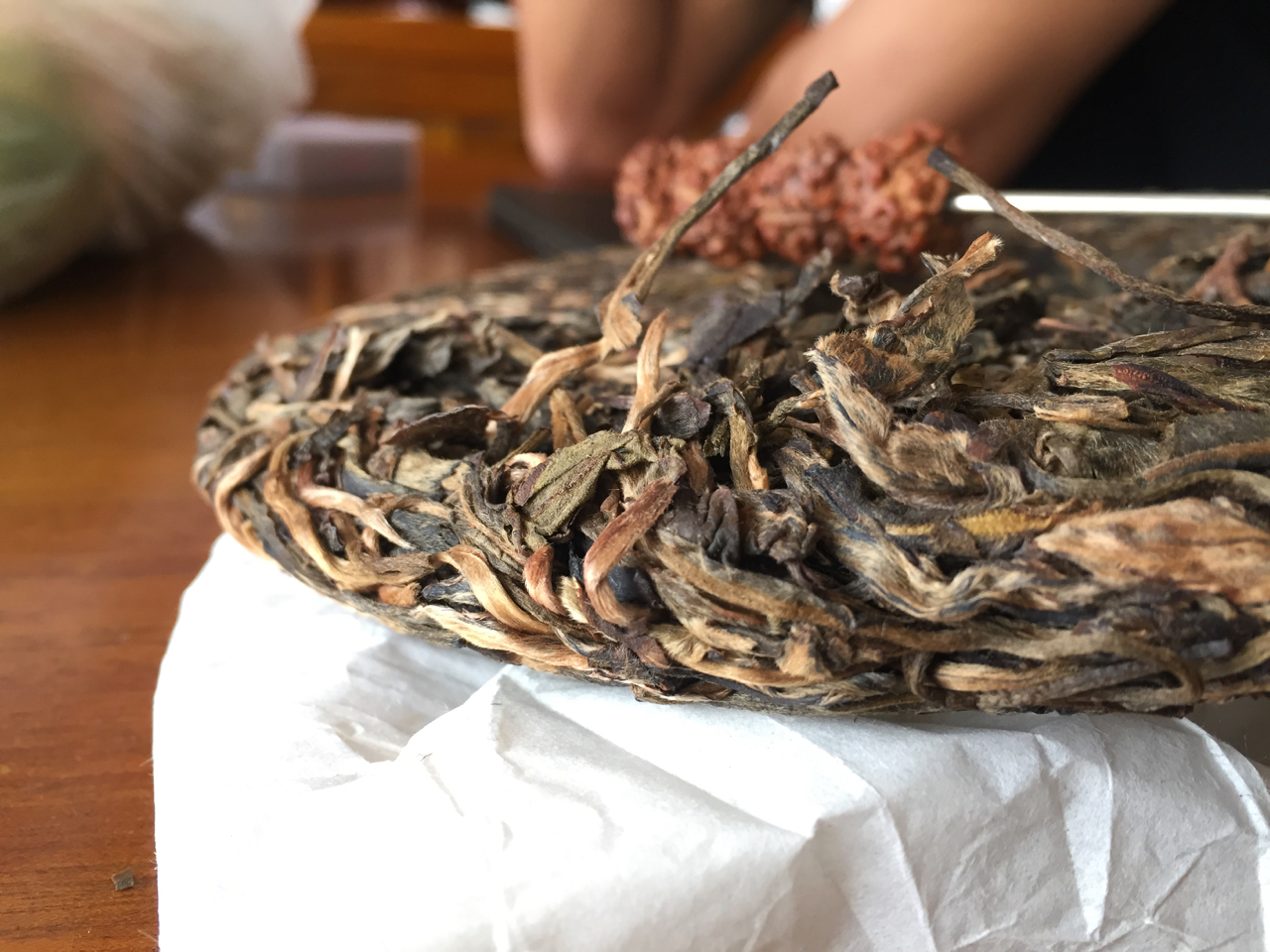
A parting shot that hangs in the mind.
