
Before anything happens on our expedition, one has to actually get one’s body to the site– and this journey is often an adventure in itself. Michael will be following me a day later in Golok while I organize, coordinate and socialize a bit with old friends.
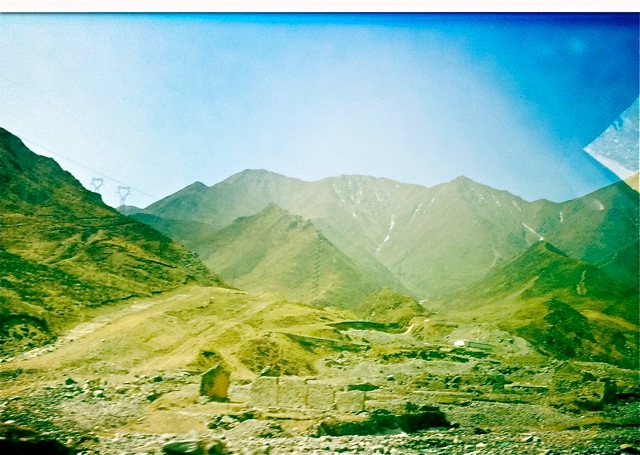
Departure
Jammed into a 4×4 in the early morning, when senses and moods are muddled, you wait to see who is along for the journey. All is well as my companions are all from Golok and in good spirits, returning home after the May celebration in Xining. Depending on road conditions, ‘driver conditions’, and the errant fates, our journey should take between 8-12 hours.
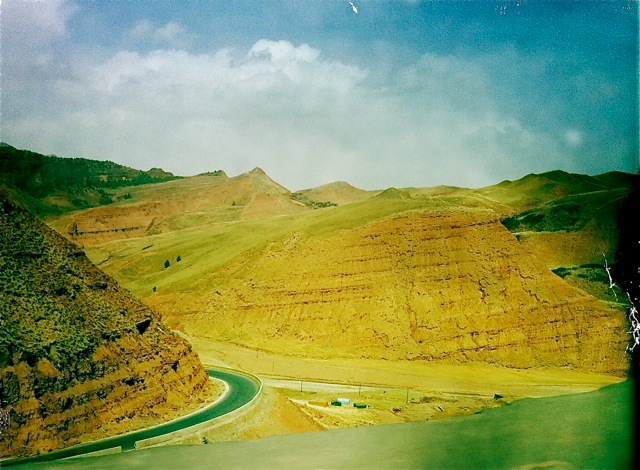
Heading deeper into the high arid regions of Golok
Driving south one enters a world of desiccated turf, scrub and mountains. Giant expanses that defy the imagination with their breadth and space. Entire voids of colour open up. Hills that look to have been gently rubbed into soft lines roll off into the horizon. Brick and mortar winter homes (a fairly new introduction for the nomads) sit like lonely square blocks. Some of the dwellings are still inhabited while others look forlorn and long forgotten.
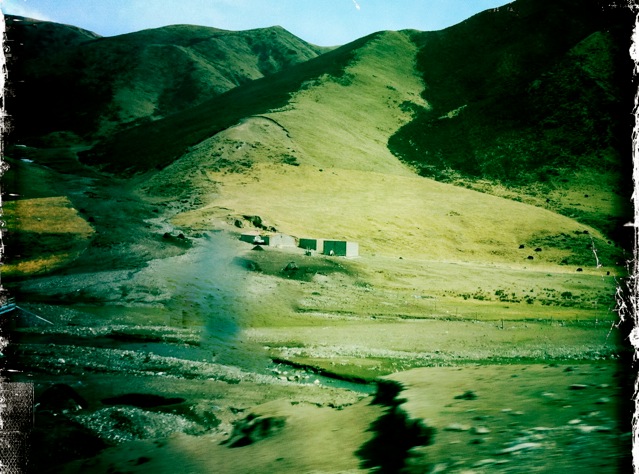
Nomadic winter dwelling
A hodgepodge of scenes unfold as cultures, new and old and urban and rural mash together along the colourful roadsides. Mosques and white skullcaps are brilliant under the sun, Tibetan nomads in their long indestructible chupas (full length woollen coats), herds of hyperactive goats wander at will across the highway and all around us the hills give way to more hills.
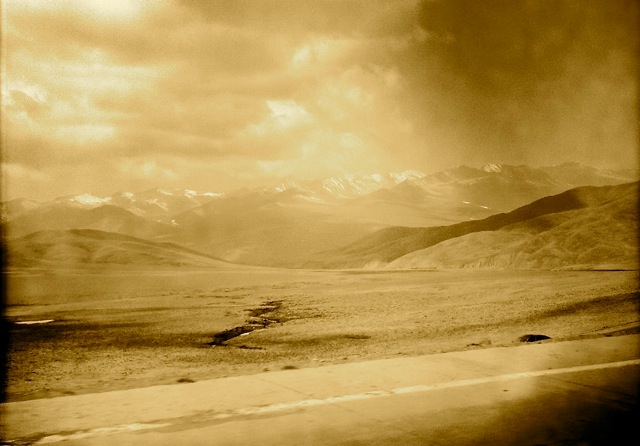
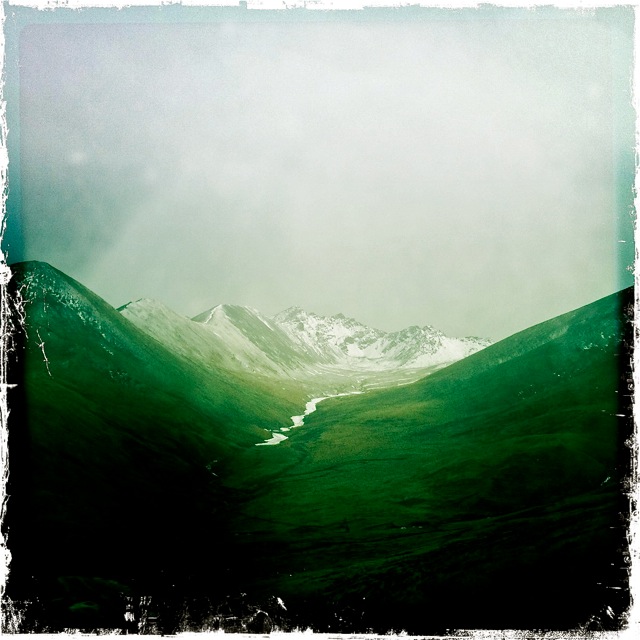
Unending valleys under distant snow peaks
One consistency throughout the journey, and one that gives me comfort is the distant snow line of mountains on every horizon. It beckons and somehow in my mind at least I view them as guardians, ushering us deeper into their protective folds.
Sandstorms whip up errant objects and pitch them kilometres away randomly, and erase landscapes at will. Nomadic families trudge across the massive spaces caring for their herds of yak, which appear as black specs. Eventually the open expanses become climbs as we ascend higher in the mountains and the road bends and curves on a series of switchbacks, presenting new vistas every minute.
It is caterpillar fungus (en.wikipedia.org/wiki/Caterpillar_fungus) season, one of the few dependable sources of income for the Tibetan nomads and they can be seen climbing higher into distant ranges to collect these precious nuggets.
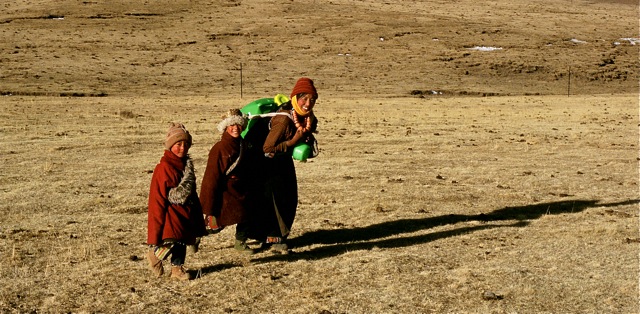
Nomads are perpetually on the move
A mainstay within the Chinese menu of medicines, I’ve always been surprised at how few Tibetans actually use these natural stimulants.
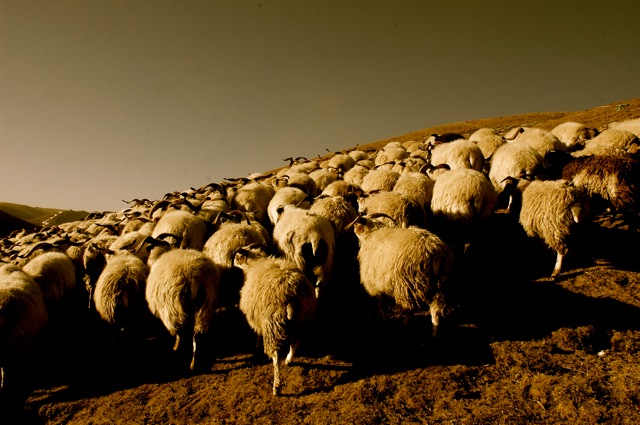
Sheep in the thousands create their own moving landscapes in Golok
Just as suddenly as the brat sun appears, it is suddenly blocked as a cold grey front moves in and turns the warm tones to cold in minutes. It is as though the sun’s allotted time has passed and now the other elements may have their say. It is now that the landscape starts to feel truly isolated. It seems too, that life has suddenly disappeared.

Sun Disappears
Finally reaching Golok in a gloomy dusk, the journey – this portion at least – is finished. Snow high in the mountains peak out through the purple-grey air as though in welcome. Upon arriving locals tell me very quickly that the regions we propose to trek haven’t yet warmed and snow and winds will be harsh.
My hosts, old friends, hustle me in for an entirely local meal: boiled yak meat, steamed yak dumplings (moms) and for desert a specialty of this region, fresh tongue-curdling yoghurt with sugar and ‘Drolma’, a root that is also a medicine for excess heat and sore throats.
Sleep comes amid shrieking mountain winds funnelling their way down through the valleys. Mountain winds have their own very special welcoming.
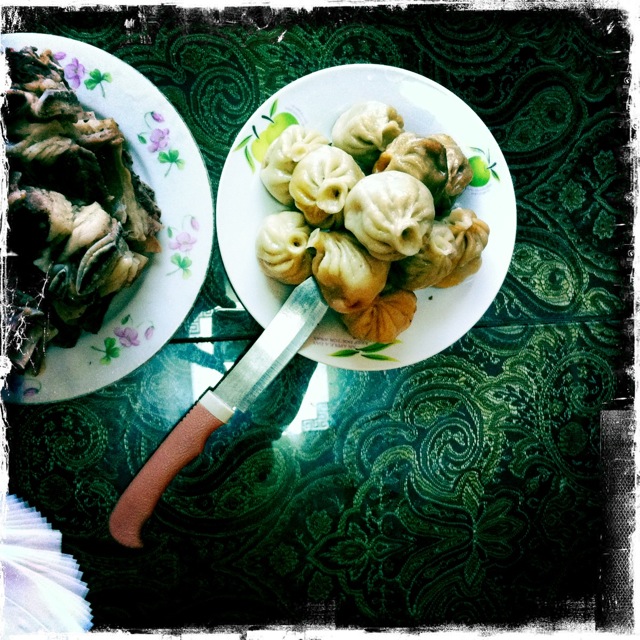
An Amdo (Qinghai) specialty that every local is proud to serve, especially in Golok

Seems to be a lot of meat and cheese in the local diet, Jeff. Do the nomads ever get vegetables and fruit? If not, how do they get adequate nourishment?
Thanks.
Best wishes,
Peter
This is where tea comes in….providing vital vegetal complexes, amino acids and catechins (though the nomads don’t use these terms, they certainly know intuitively of tea’s benefits), and the abilities to break down all of the fatty compounds. Have to say that the high protein diets do seem to work, with the dairy products providing vitamins, minerals and all sorts of high octane goodies. Other aspect is that the diets here don’t take in a lot of sugars, and the yak and sheep which provide so much nutrition graze on some of the cleanest lands I’ve had the pleasure of visiting. The locals have adapted to their simple diets as well, and it must be said that most indigenous cultures, when left to their own devices, do quite nicely without the ‘treats’ and over processed additions of the west.
Jeff
Jeff, does the ancient Tsalam actually start on Golok?
Also, will you be travelling south towards Tibet or towards Suchuan?
I am trying to follow your journey on the map, so any place names that you could provide would be much appreciated!
Thanks.
Best wishes,
Peter