
Michael and I are back in our beloved hinterlands driving deep into the nomadic territories of Gansu province. Continuing my travels into the frontiers to witness a very special way of life change. In this part of the world at least the frontiers are often both the most dynamic and the most remote – change and the modern world’s goodies come swiftly but seem at times to miss entire landscapes and valleys.
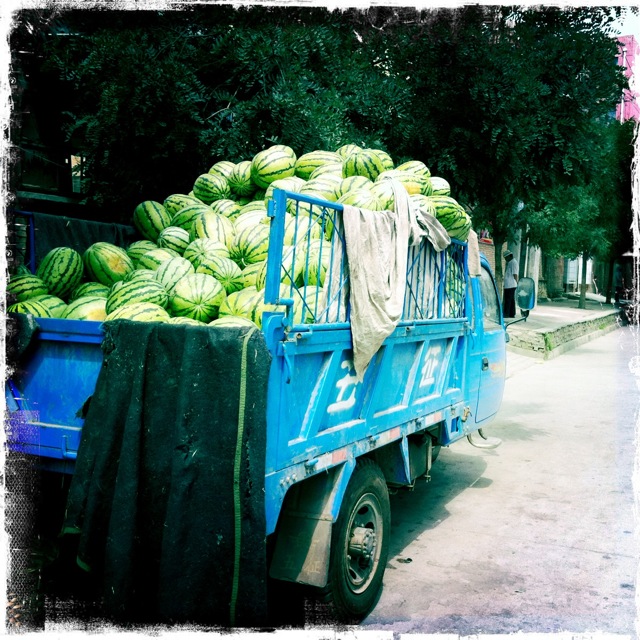
Watermelons in this part of the world reign supreme – for good reason
Arriving to Lanzhou by flight we have little interest in remaining. Our destination is southwest to Linxia for the night, which will provide a stepping off point for our journey further south into the remote highlands in and around Maqu.
The province has long been a blend of Hui Muslims and Tibetans – trade and mountains are (like many of frontiers along the Tibetan plateau) an inevitable part of the vibrant history of the place. Linxia is seeped in dust but the speed of life is, what I’ve come to love in any lands that are slightly beyond the attentions of the masses – slow and ‘human’.
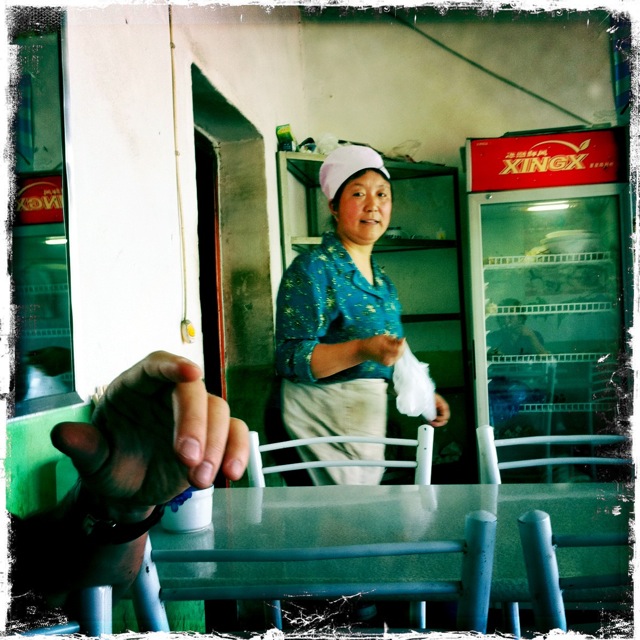
A Hui hostess comes around to serve the boys
Hui ‘Halal’ restaurants line the streets, tidy shops somehow remain dust free and the colourful kerchiefs set off the slightly exotic featured women. The Hui have long mastered business dealings, operating as middlemen where few others would tread. Disciplined and unified the Hui offer up a tantalizing history of perseverance and toughness.
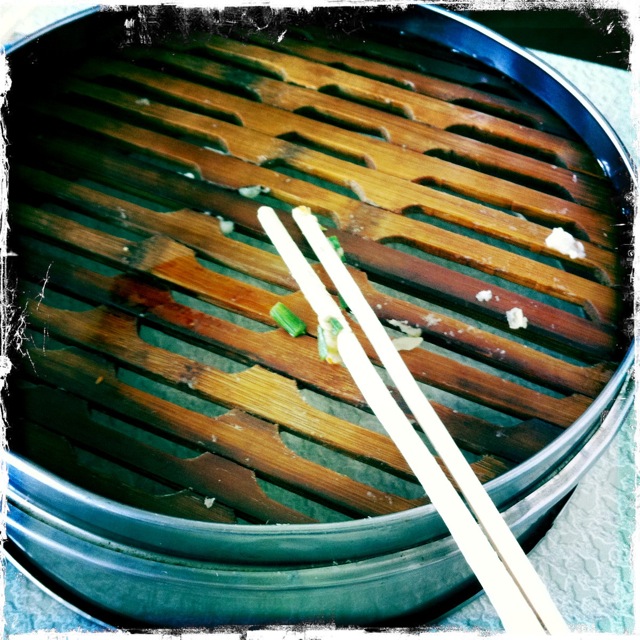
Yet another successful dish – dumplings - cleaned up
There is in Linxia a feeling of spartan efficiency and the sense that the people have learned to thrive and survive with less – the only hints of opulence and ostentation are the seemingly endless mosques, which erupt in every roadside town. Ornate and symmetrical they offer up a little bit of something borderless, and contrast to the lush greens and endless rolling mountains.
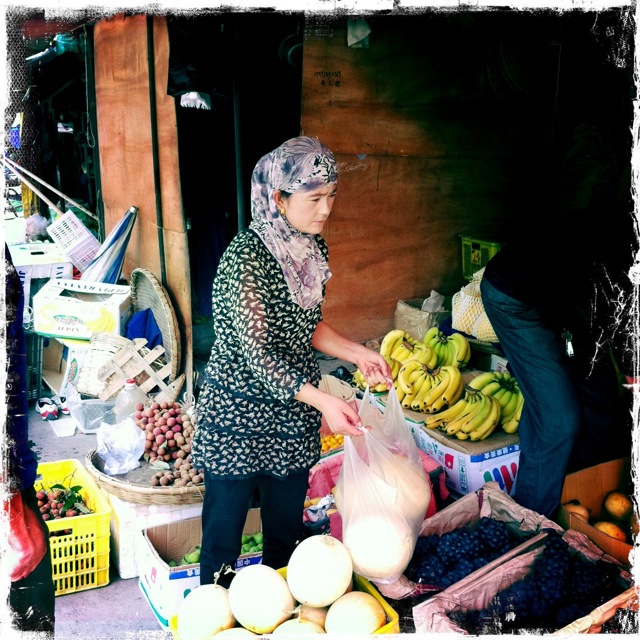
Very patient a fruit vendor waits an eternity for us to pick our goodies
Michael and I spend the night in one of those bizarre hotel rooms that one often finds in China – cheap, clean, with very suspect ventilation and faucets. Restless to get out of the city and into the mountains we find a driver who will take us to Maqu into the beloved hinterlands.
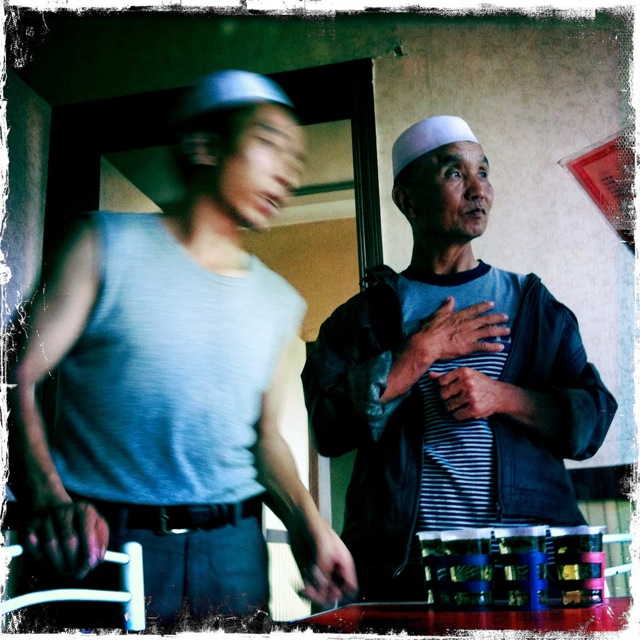
One of our many precious ‘fixers’, known as ‘Ma’ (right) organizes another feast for us
Morning comes with the soft lush sounds of the Mosques’ call to prayer, and our driver, himself a local Hui Muslim, whisks us off in the famed and fabled ‘mien bao che’, a tiny van. We know now that the hills are coming and the start coming fast.
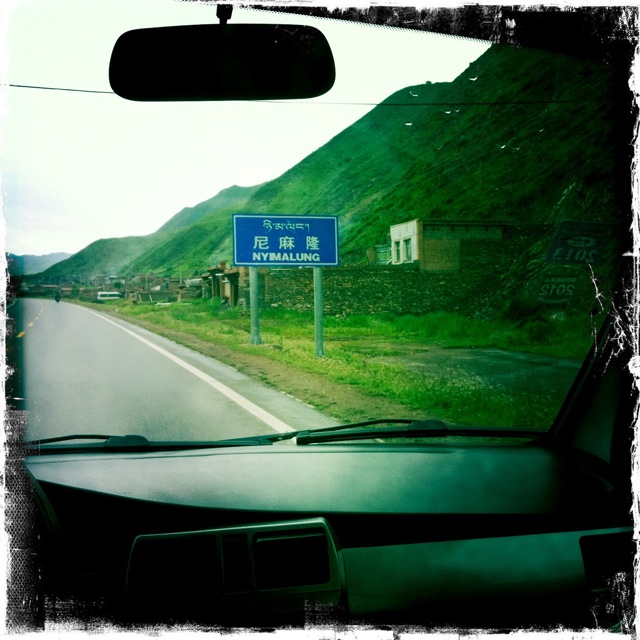
The Tibetan town of Nyimalung, where we pick up one of our guides, Somje

Interesting that you are moving through Gansu, Jeff. If I am not mistaken, the province was an important part of the fabled ancient “Silk Road”, so there is lots of multicultural history there.
It would be interesting to hear how the Muslims & Tibetans get along, and how their lifestyles & outlooks differ. Part of the lure of your writings for me are the descriptions of the “ancient ways”, and how they can help us (i.e., me!) today.
Best wishes,
Peter
Gansu (as you mention) has long been a kind of gathering point of routes and cultures – sand dunes, cities of dust and snow peaks also make it a kind of dividing point of the Qinghai Tibet Plateau. Though there have been tensions between the Tibetans and the Hui peoples (the muslims of this region), there has also long been an appreciation of eachother’s abilities in business. Many of the Tibetans stay within their own ‘folds’ with their herds, fungus and mountains while the Hui (long known for their astute dealings in business) act as middlemen. This is certainly the case with our recent travels…the Hui buying products direct from the Tibetans and then selling them on. Interesting that in many cases very little has changed – computers, etc mean very little out here. It is the person’s word (or lack thereof) and reputation that is essential and business is done face to face.
thanks for the comments Peter
Your comment that “It is the person’s word (or lack thereof) and reputation that is essential and business is done face to face.” is a very important point. Such a shame we have lost that type of personal relationship here in the West.
Best wishes,
Peter
Yes, but with a few cups of tea, some time and a little bit of ‘will’ we might yet find our way to re-realizing this way…or maybe not.
best to you Peter,
Jeff