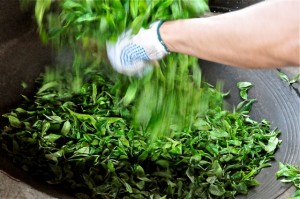
Puer´s Ancient Green Home- Part I

“with a cup of tea in front of you, you do not lie”

Dai elder


The Where’s:      Southwestern Yunnan, Xishuangbanna, Pulang Mountains
The Who’s:         Xiao Yang, Hani, Pulang, Dai, Wa peoples
The What’s:       Sheng/Raw/Green Puer
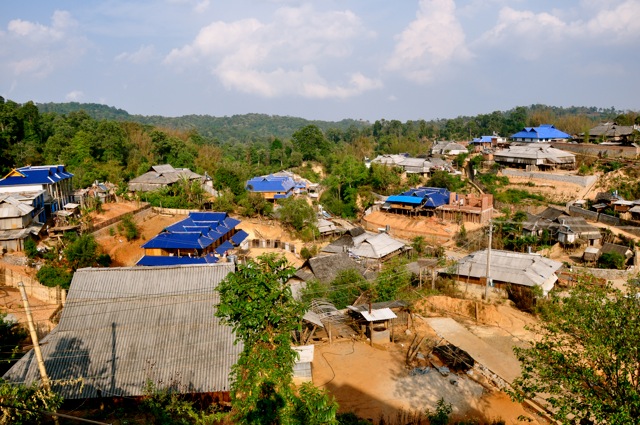

In tea circles Lao Banzhang town resonates as a heaveyweight. Lying within the Pulang Mountain Range of southern China it is known for robust and potent ‘sheng’ (raw/green) Puer’s.

Hunched forward in a kind of rigid prayer, my hand is welded onto the passenger seat’s hand rest knowing full well that even a momentary release of grip and I will be thrown about the inside of the pickup like fluid. Xiao Yang drives in the casually reckless but thoroughly competent manner of locals. Fluid one moment, muscular the next, all the while chewing on a cigarette that refuses to burn down. The fingers of his right hand are stained – tea stained. He has since young, clipped tea leaves from the stems and I view these stains as natural tattoos of honour in my very biased books.

As we jolt around in the cab Xiao Yang once in awhile utters a “whoaaaaa” flicking his eyes at me in a kind of commiserate surprise that we haven’t yet perished on the road.
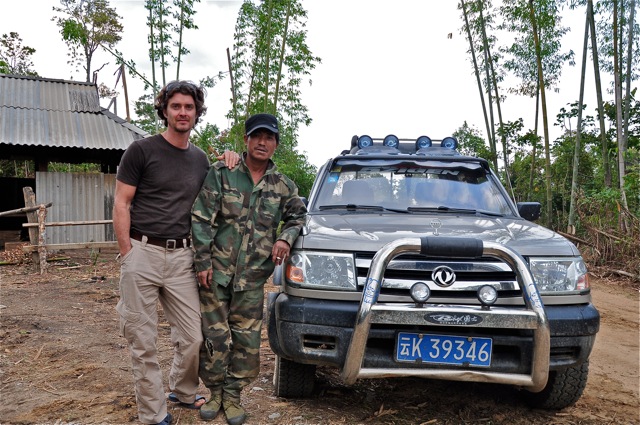
Yours truly makes an escape from one vehicle…and into another. Here a brief pose with Luo (another relative of Xiao Yang).

Slowing down is not on the menu as his foot remains jammed into the gas pedal. The often-impassable road is a desiccated mess of dust and gouges. We arrive shaken, stirred and with – not for the first time in my life – a brutal thirst.

Xiao Yang belongs to the Hani (known as the Akha in Thailand and Laos) minority, has the simmering good looks of many of the indigenous and already carries world-weariness to him – but his tea knowledge is remarkable in that it is instinctive and uncluttered with pretension.

His father is one of the headmen of Lao Banzhang – one of the planet’s most remarkable tea towns – and Xiao Yang has grown up with some of this world’s oldest tea forests as part of his physical and mental landscape. He has also enviably grown up sipping tea that for many sit at the top of the tea wish-list. Lao Banzhang (Old Banzhang), Hsin Banzhang (New Banzhang), along with many tea towns tucked into the Pulang Mountain range constitute a tea strip that for many is unequalled in the Pu’erh world. Served strong and simply by the locals, tea from this area hits and affects areas of the mouth never before touched and then disappears down the gullet leaving a sweet trail.
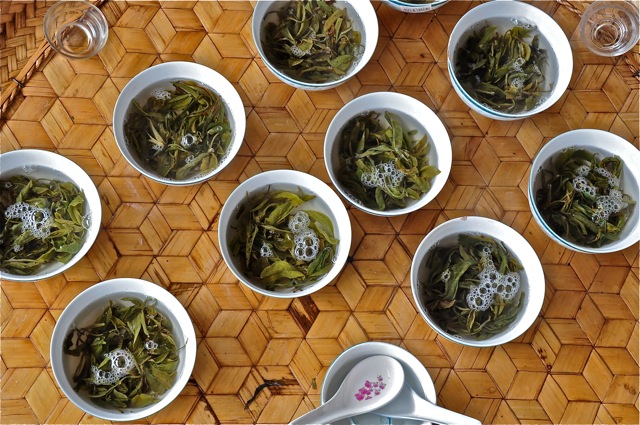
In true tea-towns teas go through a barrage of tests, with the leaves being studies, smelled and finally tasted…and tasted again and again.

Where many of the west’s self-proclaimed tea aficionados throw around tea descriptions that are at once obtuse and pretentious – garnering knowledge second and third hand – Xiao Yang is one of those refreshing personalities who sips, who smells, who sips again – and knows a tea. In his world there is good tea, bad tea and tea that will (after time) become good tea. In his ‘tea framework’ of tea-reference there are never any “peach hues”, or “hints of tangerine”. In his world of pure almost brutal teas, additions are nothing less than a desecration of what the earth provides.
Posted in Explorations, Tea | Tagged , , , , , , , , , , , , , , , | Comments Off on Puer´s Ancient Green Home- Part I

Shika Mountain – The Forgotten Guardian I

“Know when to rise and when to retreat

if you wish to see another sunrise”

– Himalayan muleteer saying –

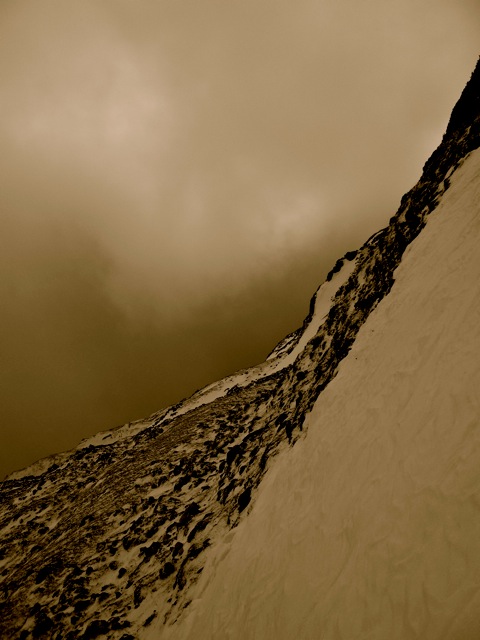
There are mountains that quietly come under the heading of ‘understated beauty residing in plain site’; Shika Mountain in northwestern Yunnan Province, just kilometers west of Zhongdian, Gyalthang (or in its most recently purchased title, Shangrila) might easily fall into that category. Shika, like many such eruptions of stone, invite and tempt with their promise of ‘another place’ and another space. It is what lies beyond that interests, as opposed to its face.

What makes a mountain, a body of water or a simple tree sacred to the Tibetans is a belief in its earth-bound sanctity, an irony considering the very remoteness of the great mountain lands. Shika and its surroundings remain seen but little explored by all but that essential of the highlands, the yak.

Far from being immense, it is at 4,392 metres, more of a subtle block that leads to a range that in turn ushers one to more interesting places. Mountains the world over have this ability to hint and inspire of places in the mind – but beyond the eye. This very fundamental feature has eternally drawn wayward wanderers, adventurers, and masochists to the earth’s peaks.

Shika (in the local dialect of Tibetan Shi means sacred location, and Ka simply means place of offering or snow) is, like many Himalayan spires and ranges, part forlorn and part magnetic – drawing one closer to sate a curiosity and test mortality. It is a mountain that acts as a conduit to other lands, other mountain ranges and it holds a bit of magic. The valleys and passes beyond and behind lead northeastward toward the great snow mountains – toward the Himalayan Plateau and that powerful harbinger of water – the Yangtze. The surrounding valleys long ago played a modest part in ushering caravans laden with goods and bodies onto the more significant trade routes heading to the great market towns.

Claw lines scratch in its slopes tell of centuries of logging and transport by locals. Striating paths crawl up only to disappear in yet another fold of stone and forest. Villagers below the range often warn of winds that gust down upon them – the belief is the winds coming from the north or west out from the Himalayas are to be seen as warnings of pending storms. Wind too, like the sacred elements of wood, water and stone carries meaning that is measured in an unambiguous quote of Tibetans, “Wind is the origin of all things”.

Moving up into the greater Shika range my intention is (as always) to visit a place that is, from down below, completely unseen and unpredictable.

November and December brings the first signs of powerful change; ‘winter change’. My access route has remained the same for years – an aged pathway, etched into the earth heading upwards behind the village of Bulun. Striating at times, zigzagging at others, the pathway weaves upwards on a journey that is seemingly endless.

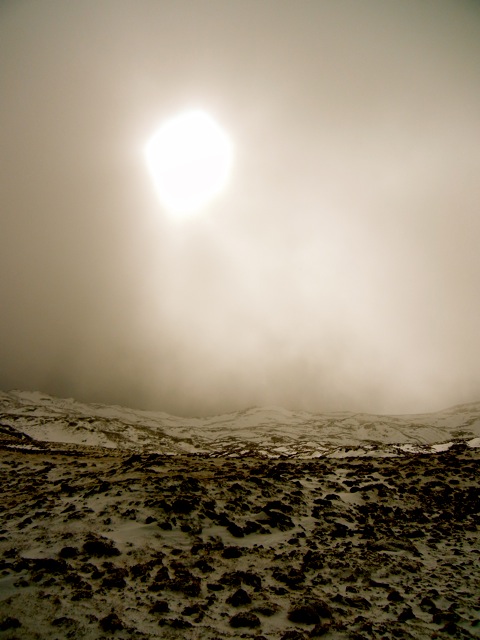
A steady plodding pace leads in hours to a white furious world of pellets driving horizontally through the shrieking air. It has become no less than a gorgeous winter tempest that in its force erases visual references. Mountain’s rampant power hints at why so many see its empires as sacred. Nothing dictates the natural elements within its great walls.

Posted in Explorations, Mountains | Tagged , , , , , , , , , , , , , | Comments Off on Shika Mountain – The Forgotten Guardian I

Welcome to the Jeff Fuchs Tea Blog

It seems only fair that this first tea entry begins where the ‘green’ begins – tea’s humid and understated roots. Here, where tea has been nurtured virtually unchanged in all of the patient centuries and where still today the green leaf is treated with a reverence that speaks to a long and gentle union with both man and soil. Here it is a food, a friend and an essential. Asia’s great ‘commodity’ here, still retains its primary roles as unifier, cure-all, and simple beverage – though in a typical bit of tea-irony, these teas are prized above all others by the private buyers and purists, who will happily part with enormous amounts of life’s other ‘green’ (cash) to quietly add a few kg’s to their private stock.

In Yunnan province’s indigenous southern stronghold, where mists hold sway and heat pervades everything, tea trees have been allowed to evolve unencumbered, reaching metres into the heavy air. Rich soil, undulating terrain and a tea pedigree in its veins makes the area a ‘tea mecca’.

 While the pace of life slows here, there is an increase in smiles. The wiry and tough Pulang, Dai and Wa peoples – tea’s ancient harvesters and care-givers, the Hani (Akha) and Lahu, (who have had the tea knowledge passed down to them), produce teas of stunning simplicity. Tea’s here are consumed green and potent with no insulting additions made. This is the dwelling place of Puer (Pu’erh) tea – big leafed, sun dried – and as this tea reaches ever-widening ‘sippers’ it is impossible to overstate how important the views of the indigenous growers are.

Posted in Explorations, Tea | Tagged , , , , , , , , , , , , , , , , , , , , | 5 Comments

Articles by and Interviews with Jeff

Here you will find links to tea and mountain related articles written by Jeff Fuchs as well as interviews with Jeff Fuchs. A little bit of selfish indulgence of two needs.

Article in Kyoto Journal

Article in Outpost

Article at The Teamporium

Article in Silk Road Foundation Newsletter

Interview with Wild China

Interview with GoKunming

Interview in Toronto Star

Live Interview on CBC

Interview on CCTV Canada AM

Posted in Media, Tea | Tagged , , , , , , , , , , , , , , , , , , | 1 Comment

Global Tea Ambassador

In keeping with a ‘love of the green’ I have entered into an agreement with Templar Foods to be their ‘Global Tea  Ambassador’ which gives me an even greater excuse to dig into the world of tea. Stories, videos and many hours of slurping will be recounted in detail.

Link to Templar Foods

Posted in Media, Tea | Tagged , , , , , , , , , , | 1 Comment