
We are heading to one of Xiao Yang’s ‘uncle’s’ homes for a sitting and sipping of a potent new batch of sheng (raw/green/unoxidized) Puer. Here the black Pu’erhs are referred to as “candy”, something “useless” and worse – something that utterly diminishes the classic bitter-sweetness of a tea. Once, when I casually mentioned to him that many refuse to drink any tea but ‘aged’ Pu’erh, Xiao Yang laughed, took a pull of his cigarette and said, “This is a foolish idea but if it helps sell our tea, what can I say against it. Tea should be fresh and strong. One can only know a tea’s quality if it is tried young.”
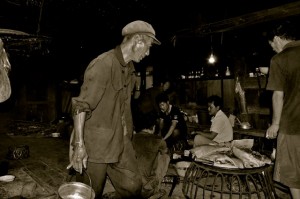
The moment we arrived to Xiao Yang’s uncle’s home, the uncle sprang into action, preparing that one vital necessity for tea: water.
We arrive to a home with a pointed thatched roof, and a withered ladder propped up to access the second story home into the home. Inside, there is not even a hint of daylight sneaking in. A languid and aquiline dog lounges with an eye on us.
In Yunnan’s south there is the perpetual hanging smoke in the air as if fires never extinguish, and with it the scented air takes on an almost perpetually narcotic effect.
Here there are no formal introductions made in the village. If you come with family you are almost beyond reproach and if you are coming for tea you are, in the eyes of locals ‘one of the enlightened’.
A round table awaits us beside a crackling fire. Hung above the fire is a kettle which gently rumbles – waiting. The uncle, a drawn handsome man with spectacular cheekbones, beckons us with long tea-stained fingers to sit. He squats by the fire and swivels himself around to a bamboo basket brimming with the familiar dried leaves of my dreams – tea from the ancient trees that surround the village. Variously called la or lo by the local Hani, ‘tea’ remains ubiquitous here – an ever-present member of the absolutely every event and moment.
One of the tea world’s great maladies is mixing (and calling) old tea tree leaves with inferior smaller tea tree leaves. Not that the tea is bad, but it is not in anyone’s eyes a true ‘old tree tea’ – and this constitutes a kind of fraud.
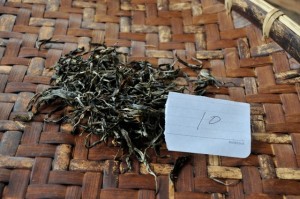
Tea batches are numbered and each number corresponds to a batch, location, and picker. Number 10 was a tea that set the tongue singing.
Grabbing a handful of leaves, uncle simply throws them into the pot, which he unhinges from its little branch above the fire. He waits just seconds before using that first infusion to ‘wash’ and heat bowls. A second hearty infusion is set before us. Before now, uncle has barely acknowledged Xiao Yang and I. Now his glowing eyes rest on my bowl, which is happily tilting into my mouth.
Lao Banzhang tea is famed for both its ko gan and wei gan – the abilities to stimulate both the sides of the tongue and then finish in a bitter sweet tang. It is not tea that seeps sweetness or chemical essences into the mouth, but rather it is a tea that inundates the mouth with the taste of earth and the taste of green power. Limited harvests and virtually unchanged production methods along with perhaps the earth’s most perfect tea producing trees ensure that the tea remains consistent and remarkable. Much like the tiny bodegas of Italy that produce limited bounties of exceptional wines, Lao Banzhang and other tea nooks are tiny heavens to the tea ‘inclined’.
Uncle sips his tea, his eyes never leaving my face. He nods at me and I nod back which is followed by Xiao Yang arching his eyebrow in a question. I give yet another nod which is quickly followed by Xiao Yang’s “It is from our village, of course it is good…a bit bitter though”.
Teas from Banzhang (most often refers to two towns) are picked, ‘fried’, dried with a combination of sun and shade, and consumed.
The results are potent….and pricey, with Spring first flushes easily running into the hundreds of dollars per kilo. These big leaf specimens can also fearlessly claim to be one of the globe’s great flag bearers of the Pu’erh world.
One of uncle’s comments before we got down to the heavy drinking session (which would in time include some potent local corm whiskey) perhaps summed up best the region’s simple tea philosophy, “Give each tea some time, some sips and then let your mouth decide whether it is good”.
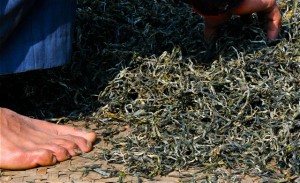
In tea towns such as Lau Banzhang there is informality between the sacred leaves and the precious harvesters. Here leaves dry on a rooftop.

“Tea must be fresh and strong” I like that. But it’s funny, because this is pretty much the opposite of the “older-is-better” pu’er wisdom you usually get told, be it at the tea shop in beijing or from tea “experts” all around the world. And I must say I had an old raw puer recently which was a real delight. But I understand that in order to judge a tea’s quality it has to be fresh (and yeay I like it strong and bitter). Old tea is probably just too smooth to taste its destinctions and nuances.
What I still don’t get is why certain pu’er teas are said to be specifically good for storage, something I often hear. It doesn’t make sense to me. If it’s better quality it’s probably good for both, immediate use and storage. I have a feeling Xiao Yang’s uncle would laugh at this, too =)
Thanks for sharing these great tea-stories with us, Jeff!
Good to hear from you Gabriel. I see you’ve been busy slurping.
From speaking with the people that grow, harvest and have lived with these tea trees I always have a lot of time for their unpretentious observations on tea. Some hard and fast rules that I’ve heard countless times are: “know the source of the tea” and “the less production (post picking manipulation), the better one is able to judge the tea”. Many in the ancient tea forests often remind me that any manipulation of a tea leaf beyond the proper picking, withering and simple drying actually deceives from the real core tea taste. It seems that great tea producers are known for their abilities to manipulate and ‘create’ a tea from the original leaf, whereas with the world’s oldest tea trees’ tea, the people don’t want any manipulation whatsoever of the essential and natural tea taste. Many of the planet’s greatest teas are simply plucked and left to dry with little or no manipulation whatsoever.
One of the reasons that forced ageing isn’t necessarily a great thing is that it does flatten the tea taste’s ‘highlights’ or bitterness. A naturally aged Puer can be a real find, but they are things of rare beauty and again I think one has to find a great source and trust them. Friend of mine, Neddy Luo, who studied tea for 5 years also refers to artificially fermented Puers as “candy” and something “that takes entirely from tea’s innate qualities”. As for Xiao Yang’s uncle, I think he is one of those precious ‘ancients’ who’s observations on tea and life would fill many a volume.
good drinking Gabriel.
Jeff, I would be interested to learn how long these tea producers allow their raw puers to age, especially if they like them “fresh”.
And, related to that, what level of oxidation and/or fermentation do these teas acquire?
I echo Gabriel’s thanks, Jeff, for providing us with such wonderful (and rarely-found) stories.
Best wishes,
Peter
One thing I’ve heard many times is that a Puer tea, if good, should taste full and strong 4 months after it has been picked. Teas generally get flatter in taste as they age, so the idea of a 30 year old tea tasting ‘better’ or more ‘tealike’ than a raw ‘sheng’ Puer is a bit of a myth (and a myth that can cost many many dollars needlessly). Locals, (and I always defer to their ‘tea sense’ before making any decisions) will say that a “fresh tea” is anything purchased within a year after it has been picked. I think the tea taste question is very subjective, but if one has informed the tongue with knowledge of what certain flavours, hints and bitter blasts mean and what they tell about a tea, one can at least ‘know’ a tea.
As for oxidation, an artificially and fully fermented (100%), oxidized tea left for a month in a controlled environment – being flipped and sprayed to maintain humidity (along with the odd addition of bacteria and moulds in some cases), might emerge from this process looking (dark), and tasting (earthy, flatter) like a 10 year old naturally fermented or aged raw tea. The tastings I’ve done with naturally aged teas that have been found in attics of Hani people always carry a longer tang in the mouth than their artificially created brethren, and have a stronger impact on the mouth. Genuinely old teas….teas that have aged on their own in reasonable environments are rare things of beauty and the first thing many tea hunters will do when entering an indigenous harvester’s home is search the attic or old cupboards with a flashlight for these old gems. Strangely enough most of the indigenous pickers don’t mind at all if the tea is carted away, as they much prefer the fresh green bite of fresh 3 month old tea. Getting a thirst on just thinking of it.
best Peter,
jeff
Fascinating information, Jeff!
Many thanks.
Best wishes,
Peter
This article was very informative, and will have me tasteing tea in a different way ; especially the young teas. Thanks ……
The young teas are often something a bit foreign to mouths at first but they carry so much of the essence and taste of the tree, the earth itself.
Good drinking Howard.