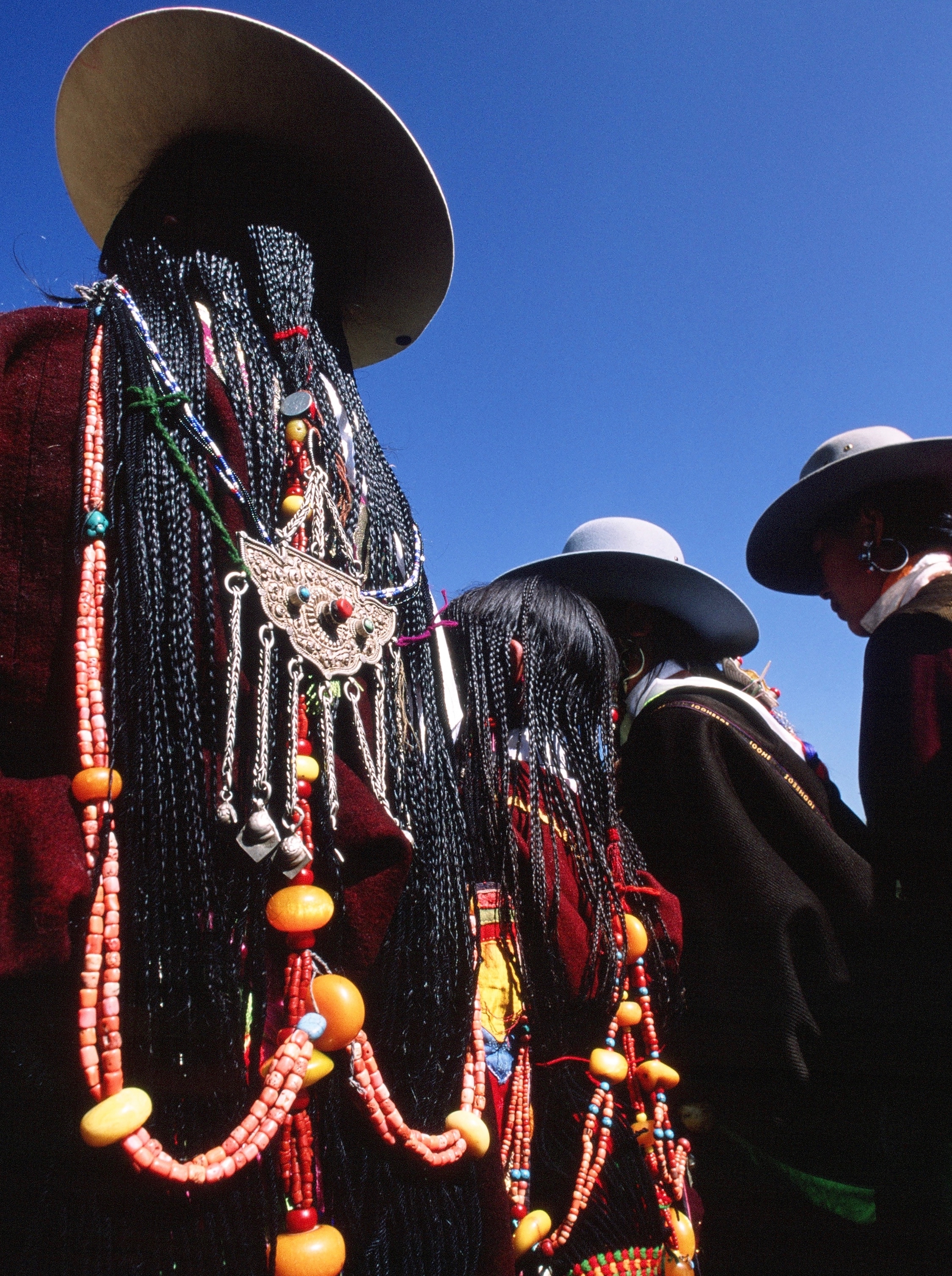
Nomadic women of Ganze gather on a grassland to take part in a horse festival. It was through and over such high grasslands that the Tea Horse Road moved towards Dzogong, Chamdo, Lhasa and beyond. Nomads and their lands were a vital part of the the route’s core, transversing their lands, and enlisting them for safe passage. Horse festivals were vital stops for caravans as it was here where horses, mules, tea and other commodities could be traded and bartered. They remain to this day, gathering occasions to share and pay homage to the horse and the skillsets needed to manage them. Food, family, and fineries meet for days at a time. On this day, the nomadic community showed up in all of their finery, gleaming with silver, corals, and turquoise as these festivities were in some ways as much about gathering and bonding as they were about horses. In eastern Tibetan regions of Kham, many women braid their hair into 108 separate ‘micro braids’, which references enlightenment and is an auspicious number in Buddhism.

About JeffFuchs
Having lived for a decade in Yunnan, Fuchs’ work has centred on indigenous mountain cultures, oral histories along with an obsessive interest in tea.
Fuchs is the author of 'The Ancient Tea Horse Road' (Viking-Penguin) and he was the subject of 'The Tea Explorer' documentary based on his exploration of the Tea Horse Road.
His photos and stories have appeared on three continents in publications such as Kyoto Journal, TRVL, and Outpost Magazine, as well as The Spanish Expedition Society, The Earth, Silkroad Foundation, The China Post Newspaper, The Toronto Star, The South China Morning Post, and UNESCO amongst others. Various pieces of his work are part of private collections in Europe, North America, and Asia. Fuchs served as Asian Editor at Large for five years at award-winning Outpost magazine.
Jeff has worked with schools and universities, giving talks on both the importance of oral traditions, tea and mountain cultures.
His recently released book ‘The Ancient Tea Horse Road’ (Penguin-Viking Publishers) details his 8-month groundbreaking journey traveling and chronicling one of the world’s great trade routes, The Tea Horse Road. Fuchs is the first westerner to have completed the entire route stretching almost six thousand kilometers through the Himalayas a dozen cultures.
Fuchs partnered with Wild China to create a journey along the Tea Horse Road which National Geographic Traveler called one of the "50 Trips of a Lifetime".
He is co-founder of Akahiao Nature Institute on the island of Hawai'i along with his wife, Julie Rogers.
